Til hovedsiden

Publisert

The Windmill in European Art (1500-1850): A Journey Through Time and Landscape

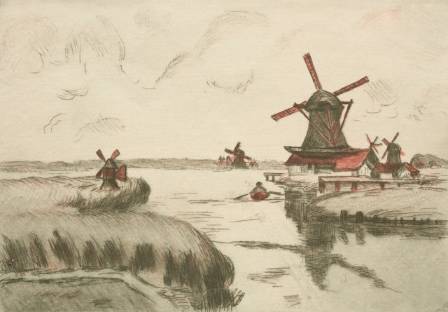
For over six centuries, windmills have been a distinctive feature of European landscapes and a popular subject in art. From their twelfth-century origins to their peak in the mid-nineteenth century, these towering structures captured the imagination of artists across the continent. This article explores how windmills were depicted in European art from 1500-1850, examining their technical evolution, cultural significance, and artistic representation.

A

Alexander Morgan

Signatur

The Windmill in European Art (1500-1850): A Journey Through Time and Landscape

Introduction: The Historical Significance of Windmills in Art

For over six centuries, windmills have been a distinctive feature of European landscapes and a popular subject in art. From their twelfth-century origins to their peak in the mid-nineteenth century, these towering structures captured the imagination of artists across the continent. This article explores how windmills were depicted in European art from 1500-1850, examining their technical evolution, cultural significance, and artistic representation.
Before the invention of steam power, windmills were essential to European economies, serving as versatile machines for grinding grain, pumping water, sawing timber, and processing various materials. Their imposing presence on hills and plains made them natural focal points in landscape painting, evolving from mere background elements to powerful symbols of human ingenuity and harmony with nature.

Early Beginnings: Windmills in Late Medieval and Early Renaissance Art (1500-1600)

The earliest artistic depictions of windmills in the period under consideration appear in the works of Flemish and Dutch masters. These early windmills were primarily horizontal-axis designs, predecessors to the more familiar vertical windmills that would dominate the landscape in later centuries.
Hieronymus Bosch (c. 1450-1516) incorporated windmills as distinctive elements in his fantastical compositions. In The Adoration of the Magi (1490-1500), a windmill stands prominently in the background, overlooking the holy scene. Similarly, in his Temptation of Saint Anthony (c. 1500-1510), a windmill appears in the right wing of the triptych, providing a grounded, familiar element amid the chaotic, surreal landscape.
The Bruegel family continued this tradition. Pieter Bruegel the Elder (1526/1530-1569) included windmills in several of his landscape works, most notably in The Procession to Calvary (1564). In this painting, a windmill sits atop an impossibly steep crag, serving both as a geographical marker and a symbol of human industry in a sacred context. The mill's circular platform, designed to rotate with the wind, adds a touch of architectural precision to the otherwise rugged landscape.
During this period, windmills were often depicted as part of idealized rural scenes, symbolizing prosperity and the harmony between human labor and natural forces. They were carefully integrated into compositions, balancing the religious and secular elements that characterized Renaissance art.

The Golden Age: Dutch Windmills in Seventeenth-Century Art

The seventeenth century marked the golden age of windmill painting, particularly in the Netherlands, where these structures were essential to the nation's survival and economic success. By the early 1700s, the Netherlands had over 10,000 windmills, transforming the flat landscape and enabling the Dutch to reclaim land from the sea.
Jacob van Ruisdael (1628/1629-1682) became the foremost painter of windmills. His masterpiece, The Mill on the Eyk (1670), now in the Rijksmuseum, Amsterdam, demonstrates his ability to capture the dramatic interplay between light, wind, and water. Ruisdael's windmills are never static; they are always in motion, their sails catching the wind, their presence transforming the surrounding landscape. He often placed his windmills at the edge of water, creating reflections that enhanced the sense of depth and movement.
Rembrandt Harmenszoon van Rijn (1606-1669) also depicted windmills, though less frequently than Ruisdael. His works, such as the etching A River Scene with a Windmill in the Distance, show how windmills could serve as powerful compositional elements, drawing the viewer's eye into the distance while providing a sense of scale and human presence.
Other Dutch artists like Jan Josefsz. van Goyen (1596-1656) and Esaias van de Velde (1587-1630) incorporated windmills into their landscape paintings, establishing a tradition that would continue throughout the century. Their works often featured windmills as part of bustling port scenes or quiet rural vistas, highlighting the central role these structures played in Dutch daily life.

Technical Evolution: From Simple Machines to Engineering Marvels
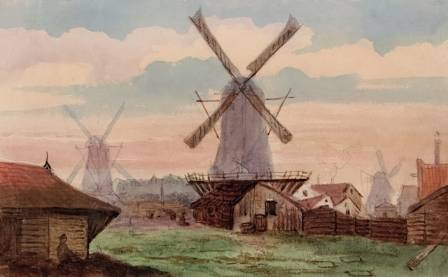
The period 1500-1850 witnessed significant technical advancements in windmill design. Early windmills were simple affairs with fixed sails that had to be manually adjusted to catch the wind. By the late seventeenth century, Dutch engineers had developed the "Dutch mill," featuring a rotating cap that allowed the entire structure to face into the wind, significantly improving efficiency.
This technical evolution was not lost on artists. They carefully depicted the intricate details of windmill construction—the wooden frameworks, the cloth sails, the mechanisms that allowed for adjustment. In many paintings, the windmill's machinery is partially visible, inviting viewers to appreciate the ingenuity of its design.
The Dutch also developed specialized windmills for different purposes: grain mills, sawmills, paper mills, and drainage mills. Artists often indicated the mill's function through subtle details—bags of grain, stacks of lumber, or the presence of water channels.

Beyond the Netherlands: Windmills in European Art across Regions

While the Dutch dominated windmill painting, artists from other European countries also incorporated these structures into their work.
In Flanders, artists like Peter Paul Rubens (1577-1640) included windmills in their landscapes, often as part of grand, panoramic views. In his Landscape with a Windmill and Peasants, the windmill serves as a unifying element, connecting the foreground figures with the distant horizon.
In France, windmills appeared in the works of the Claude Lorrain (1600-1682) school, where they were often placed in idyllic, classical landscapes. French artists tended to depict windmills as elegant, almost decorative structures, blending them harmoniously into the surrounding countryside.
In Britain, windmill painting developed somewhat later but gained popularity in the eighteenth and early nineteenth centuries. Artists like Thomas Gainsborough (1727-1788) and John Constable (1776-1837) incorporated windmills into their rural scenes. Constable's Landscape with Windmills near Haarlem (1830), after Jacob van Ruisdael, pays homage to the Dutch tradition while adding his own distinctive style.

Symbolism and Meaning: Beyond Functionality

Windmills in art were more than just accurate representations of functional machinery; they carried deep symbolic meaning.
In Christian art, windmills sometimes represented the soul's journey, with the rotating sails symbolizing spiritual transformation. The movement of the sails could also be interpreted as a metaphor for the Holy Spirit's influence.
In Dutch art, windmills became powerful symbols of national identity and resilience. They represented the Dutch people's triumph over nature, their ability to transform marshland into fertile fields. The Dutch even developed a saying: "God created the world, but the Dutch created Holland"—with windmills as the tools of this creation.
Windmills also symbolized human industry and ingenuity. Their presence in a landscape indicated productive use of the land, prosperity, and the harmonious relationship between people and nature.

The Changing Landscape: Windmills in Late Eighteenth and Early Nineteenth-Century Art

By the late eighteenth century, the Industrial Revolution began to transform Europe, and windmills faced competition from steam-powered machinery. This transition was reflected in art.
In Britain, artists like J.M.W. Turner (1775-1851) and David Cox (1783-1859) depicted windmills in a changing world. Their works often contrasted the old windmill with new industrial elements—steam locomotives, factories—evoking a sense of nostalgia for a disappearing way of life.
In the Netherlands, the decline of traditional windmills was met with efforts to preserve them as cultural heritage. By the mid-nineteenth century, the Dutch government and private citizens recognized that the complete disappearance of these structures would be a significant cultural loss.

Conclusion: The Enduring Legacy of Windmills in Art

The period 1500-1850 witnessed the rise, peak, and gradual decline of windmills as dominant features of European landscapes and art. From their humble beginnings in medieval art to their starring role in Dutch Golden Age painting, windmills captured the imagination of artists across Europe.
These towering structures served as both functional machines and powerful symbols, representing human ingenuity, national identity, and the ongoing dialogue between people and nature. As they were gradually replaced by steam and, later, electricity, they took on new meaning as symbols of a bygone era.
Today, windmills continue to inspire artists, though in a different context. The tradition of windmill painting established by Bosch, Bruegel, Ruisdael, and others has evolved, but the fascination with these elegant, powerful structures endures, a testament to their enduring place in European cultural memory.

Flere anbefalte saker

How to Start Hiking: A Beginner’s Comprehensive Guide to Trail Success

How to Start Hiking: A Beginner’s Comprehensive Guide to Trail Success

Hiking is far more than putting one foot in front of the other; it’s a gateway to rediscovering nature’s calm, strengthening your body, and finding clarity in a world filled with constant digital noise. Whether you’re meandering through sun-dappled forest trails, trekking across vast desert landscapes, or exploring wildflower-strewn alpine meadows, hiking invites you to engage with the natural world in a way that’s intimate, intentional, and deeply restorative. For beginners, the prospect of lacing up boots and hitting the trail can feel daunting—questions about where to go, what to wear, and how to stay safe often linger. But at Andina Outdoors, we believe hiking should be accessible to everyone, regardless of experience. Rooted in our commitment to sustainability and ethical outdoor practices, this guide is designed to demystify the process, equip you with practical skills, and inspire you to embark on your first hike with confidence. From choosing your first trail to packing the essentials, we’ll walk you through every step, ensuring your journey is not just safe and enjoyable, but also aligned with respecting and preserving the trails we all love.
JJoseph
Master Techniques for Drawing Rice Paddy Landscapes

Master Techniques for Drawing Rice Paddy Landscapes

Capturing the serene beauty of a rice paddy field is a classic exercise in landscape art that combines elements of perspective, reflection, and organic texture. Whether you are illustrating a vast agricultural expanse or a small terraced farm, the key to a successful drawing lies in how you organize the repetitive rows of seedlings and represent the watery surface of the soil. By applying a few fundamental artistic principles, you can create a composition that feels both expansive and grounded in reality.
BBenjamin Cole Harrington
The 2025 Ranking: Top 10 Global Wealth Capitals

The 2025 Ranking: Top 10 Global Wealth Capitals

Topping the list, the "financial capital of the world" is home to over 340,000 HNWIs and holds more than $3 trillion in private wealth. Anchored by Wall Street and a relentless real estate market, its status is unassailable.

LLucas Kelly
8 Must-Try Classic Dim Sum Dishes for Your Next Yum Cha

8 Must-Try Classic Dim Sum Dishes for Your Next Yum Cha

Yum cha menus are overflowing with options—from dumplings and steamed rice to buns and fried seafood—and there are some classic Cantonese-style dishes that are non-negotiable orders for any dim sum lover. Over years of enjoying yum cha across Asia and Australia with family and friends, I’ve stuck to a go-to lineup of these beloved bites, only occasionally branching out to try something new.

MMabel Kwong
How to Draw a Crystal Ball

How to Draw a Crystal Ball

Learn to create a beautiful crystal ball drawing with this easy step-by-step guide. Using simple tools and approachable techniques, you can produce an eye-catching and magical illustration suitable for any skill level.

HHenry Ford
15 Races in the US That Every Runner Needs To Do

15 Races in the US That Every Runner Needs To Do

For runners, the motivation to tie up our shoes is as varied as the races themselves. We chase personal goals, the thrill of competition, the weight of a finisher's medal, and the incredible community spirit. The real challenge isn't getting out the door, but choosing which iconic event to target. To help you decide, we've curated a list of the most legendary and breathtaking races across the United States.

MMatthew Lewis
Top 7 Health Benefits of Pomegranates You Should Know

Top 7 Health Benefits of Pomegranates You Should Know

Pomegranates are a delicious and nutritious fruit that has gained popularity worldwide for its numerous health benefits. This red, round fruit is filled with edible seeds, known as arils, that are bursting with flavor and packed with health-promoting compounds. Pomegranates are low in calories, yet high in essential nutrients like fiber, vitamins, and minerals. From supporting heart health to boosting exercise endurance, the health benefits of pomegranates are extensive and well worth exploring. Here are seven key reasons to include pomegranates in your diet.

NNevaeh
10 Fascinating Facts About Sunglasses You Didn’t Know

10 Fascinating Facts About Sunglasses You Didn’t Know

Sunglasses are more than just a stylish accessory. They carry a long and surprising history, blending practicality, culture, and even a little bit of eccentricity. While today we slip them on to look cool or shield our eyes, their story stretches back centuries. Here are ten intriguing details that will completely change how you view sunglasses.

KKate
Discover the 5 Most Colorful Natural Wonders on Earth

Discover the 5 Most Colorful Natural Wonders on Earth

Take a moment to gaze at the vastness of our planet, where a stunning array of colors stretches from the vibrant sky to the rich earth beneath our feet. Whether it’s painted peaks, vivid deserts, or striking rivers, nature offers a spectacular palette that captivates our senses.

JJames
A Comprehensive Guide to Selecting the Perfect Bed Frame

A Comprehensive Guide to Selecting the Perfect Bed Frame

Establishing a bedroom environment conducive to rest requires more than just a high-quality mattress; it necessitates a bed frame that offers both structural support and aesthetic appeal. Because a bed is the primary focal point of the room, choosing the right model involves balancing your personal style with practical spatial requirements. To make an informed decision, you should evaluate the frame type, the overall room aesthetic, dimensions, build quality, and additional features like integrated storage.

CConstance Mary Ellsworth